PORTFOLIO
BRITISH GAS - HOMEMOVE JOURNEY DESIGN

CLIENT
British Gas
PROJECT
End-to-end HomeMove journey
Simplifying complexity, enabling customers to self-serve
Overview
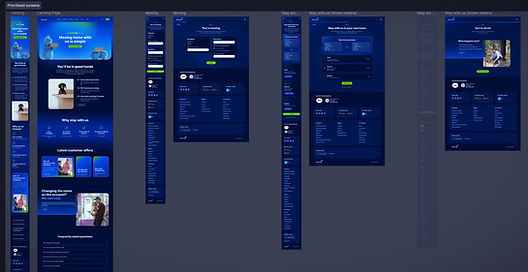
The British Gas HomeMove journey is one of the most complex and high‑impact customer flows within Online Account Management, supporting around 10,000 customers every month. The experience had become fragmented over time, with inconsistent logic, unclear pathways and friction points that disproportionately affected customers with multiple accounts.
My role
As Senior Product Designer I led the end‑to‑end redesign of the HomeMove journey, working closely with product managers, developers, data analysts and service teams. My focus was on simplifying complexity, improving clarity and enabling customers to self‑serve with confidence.
The challenge
-
Fragmented experience across logged‑in and anonymous states
-
Confusing decision logic and branching paths
-
High friction for customers with multiple accounts (around 35% of users)
-
Unnecessary steps adding 3 to 4 minutes to the journey
-
Low clarity around next steps and outcomes
-
Inconsistent patterns due to legacy UI and technical constraints
Approach
1. Mapping the complexity
I began by mapping the full end‑to‑end journey, including edge cases, multi‑account scenarios and service dependencies. This exposed hidden logic gaps and misaligned assumptions across teams.
2. Evidence‑led problem framing
Using analytics, call‑centre insights and heuristic evaluation, I identified the highest‑impact friction points and prioritised improvements that would reduce effort and increase clarity.
3. Prototyping & testing
I created interactive prototypes to validate new flows, simplifying decision points and reducing cognitive load. User testing confirmed that customers understood the new pathways more quickly and with fewer errors.
4. Cross‑functional alignment
I worked closely with engineering and service teams to ensure the redesigned journey was technically feasible, operationally sound and aligned with business rules.
5. Pattern consistency
I introduced scalable UX patterns and decision frameworks to ensure the journey could be maintained and extended consistently across teams.
4 minute
Reduction in journey time
35%
Improvement in clarity
Increased
Self-serve success through clearer pathways and reduced friction
Outcomes
-
Reduced journey time by 3 to 4 minutes through simplified flows
-
Improved clarity for customers with multiple accounts (around 35% of users)
-
Higher self‑serve success through clearer pathways and reduced friction
-
Stronger alignment across product, engineering and service teams
-
Future‑proofed journey logic with scalable patterns and decision frameworks
“Feedback on the prototype design… this is really good Rob! They really did love it! I’ve never seen the Legal & Regulations team so giddy!”
DAWN FINCHAM-WHALLEY
PRODUCT MANAGER- BRITISH GAS
What I learnt
This project reinforced the value of combining systems thinking with evidence‑led design. Even in highly constrained environments, clarity and simplicity can unlock meaningful improvements for both customers and teams.